Thursday, October 13, 2011

Wordle


Wordle is a toy for generating “word clouds” from text that you provide. The clouds give greater prominence to words that appear more frequently in the source text. You can tweak your clouds with different fonts, layouts, and color schemes. The images you create with Wordle are yours to use however you like. You can print them out, or save them to the Wordle gallery to share with your friends. 

This site can be used in art classes for students that are struggling with the use of text and image. If they can plug in multiple words to wordle, a cloud will be created that selects prominent words. Those that stand out to the student can be the words they choose for a project. 

Or as a teacher, this can be a simple day project if a student finishes with an assignment early. They can choose a topic such as the US Constitution, most common crossword answers, or characteristics of a friend. After the cloud is created, adjusted and finalized, they can print or post the final product to a class blog or add it to a class folder.

Sunday, October 9, 2011

Fieldwork Day 1: New Paltz Middle School

All I can remember from Middle School art is unmotivated students, loud noises, and ruined materials. Students that did not want to be in the classroom made it clear to the teacher and other students that they had better things to do. It was extremely disheartening to be in the class and think back about my experiences.

Going into my first day at the New Paltz Middle School I was expecting the worst. I expected crayons to be flying, students to be rubbing glue sticks on each other, and disrespect towards the teacher. To my surprise the classes were well under control and the students enjoyed being there! It was a great turnaround from my experience.

The Middle School runs on an A/B schedule and this Wednesday, my partner, Taylor Henshaw, and I were there for a B day. According to our teacher, Mrs. Sturgis, this was her "crazy" day. She explained to us that for each grade there is a theme the school likes the art teachers to work with. Mrs. Sturgis creates most lessons based on the theme.
On B days there is a second art teacher that shares Mrs. Sturgis's room, she follows the same themes when creating lessons. On A days, the teacher goes to the high school to help out there.

6th grade-identity and exploration
Mrs. Sturgis lesson- We caught the tail end of a technique project "Elements of Art" where the students simply learned and experimented with line, shape, form, color, value, texture, and space. 
Second teacher's lesson- Students created a "locker name poster." Each student wrote their name and decorated the piece to be laminated and posted outside their locker as well. When looking around, students created very unique and individual designs. Some were quite interesting! One student had balloons holding up each letter in the sky and another had all the letters of his name stacked on a desk.

7th grade- liberty
Mrs. Sturgis lesson- Students created a "locker word art project." In this project, students picked a word that described a close friend. On an 8x8 piece of paper, students wrote their word and incorporated it into a drawing and collage piece which covered the entire paper. Their final drawing was scanned and copied, each student then used their original and two other drawings for their final locker poster. Students were asked to glue the three pieces to a long black piece of paper which would then be laminated and taped to the outside of the lockers. Some words students used were epic, funny, athletic, and unique.
7th graders will be taking a field trip to see the Statue of Liberty and there they will create sketches and drawings based on their experience there.

8th- pop culture and current art
I found myself mostly interested in the 8th grade lesson. This was one of the first days for the introduction of this new project for the students. In the "Pop Art Project," students will pick someone in popular culture today and through the computer tool paint, they will create a bright colored pop art image. For the intro to this lesson, Mrs. Sturgis showed multiple short videos about 5 artists. I thought this was a great technique because it was not one long movie that students would either love or hate. They had multiple 1-5 minute videos to watch, so if they did not like it they could find information through the second video. The artists she introduced to the students were Andy Warhol, Wayne Thiebaud, Roy Lichtenstein, Keith Harring, and The Art Guys. After showing the videos she handed out a worksheet in which the students needed to fill out three pieces of information they learned from the videos.
 

Wayne Theibaud

 
Roy Lichtenstein
Overall it was an enjoyable first day and I can't wait for next week!

Le Cadavre Exquis


After searching through the site a little bit, I discovered the exquisite corpse game taken to the next level! Many of us have played this game as children or read about it in class. We have introduced the idea of creating sculptures based off the final product, adding new materials and creating a collage, and now Brendan Oliver and Brendan Randall have reinterpreted the game to create Le Cadavre Exquis.
Members of the public are invited to record a short stop-frame animation as a response piece to a previously recorded submission. The piece is uploaded online within minutes and textual narrative is then created by online participants through a narrative suggestion feature. 


Nottingham Contemporary 1st September 2011, 13:50:46

As for response from the audience, "Some people have been reflective, a few declined but the overwhelming majority have been excited and more than happy to be involved in something creative and user-generate."


Nottingham Contemporary 4th September 2011, 14:17:18

This interactive piece follows the new media literacy of performance (the ability to adopt the alternative identities for the purpose of improvisation and discovery). By having the audience dress up in costumes and react to previous videos, they create the stop motion clip by improvising and reacting to what they see.
Check out my post about Participatory Culture for more information about all of the new media literacies!

Thursday, October 6, 2011

Participatory Culture

This weeks reading was Confronting the Challenges of Participatory Culture: Media Education for the 21st Century. "According to Pew Internet and American Life project, more than 1/2  of all teens have created media content. 1/3rd of teens who have used the internet have shared content they produced."
Emphasized in the reading is a participatory culture. By these teens being involved in the culture, they are in a culture with "relatively low barriers to artistic expression and civic engagement, strong support for creating and sharing one's creations."

"New literacies" are the way students will be learning and creating. Also the way we will be teaching. There are multiple skills involved with the literacies.
Play- capacity to experiment with on'es surroundings as a form of problem solving
Performance- adopt alternative identities for the purpose of improvisation and discovery
Simulation- interpret and construct dynamic models of real-world process
Appropriation- meaningfully sample the remix media content
Multitasking- scan one's environment and shift focus as needed to salient details
Distributed Cognition- interact meaningfully with tools that expand mental capacities
Collective Intelligence- pool knowledge and compare notes with others toward a common goal
Judgment- evaluate the reliability and credibility of different information sources
Transmedia Navigation- follow the flow of stories and information across multiple modalities
Networking- search for synthesize and disseminate information
Negotiation- travel across diverse communities, discerning and respecting multiple perspectives, and grasping and following alternative norms

             I found myself returning to the concept of play and performance. Though the reading did not specify art related instances, I believe through my experience play and performance and wonderful skills to use to engage students in the subject matter.
             If I look back at my little cousins, they are playing video games, watching movies and television shows that educate them with math, art, and language. In the early stages of learning, children are geared to understand a highly stimulated type of education. I find myself losing interest in an average history book compared to a video with music in the background, multiple images on the screen, constantly changing. I was the same as a child as I am now, but I believe with consistent techniques students would grasp more then they do now.
              If my little cousins begin their education with videos and play to learn, they should be able to grow with more challenging play. As teachers, by bringing play and performance into the classroom we are engaging our students, allowing them to experience rather than lecturing hoping they listen.
            Through Theory and Practice we have learned multiple games to play with students as "warm-ups." This is something I wish I had done when I was a student. I remember warm ups being a power point presentation of a couple slides of an artists work rather than artist trading cards.

            An example I am particularly fond of is the game Medieval Space. This is when students are asked to create online profiles for various historical figures studied int heir classes. Since students are already extremely interested in social networks, why not incorporate that into a lesson? Create a Facebook for Picasso. This will allow for students to research artists and become creative with stories and images. This is definitely something I would be interested in doing with a middle school or high school level class.

Monday, October 3, 2011

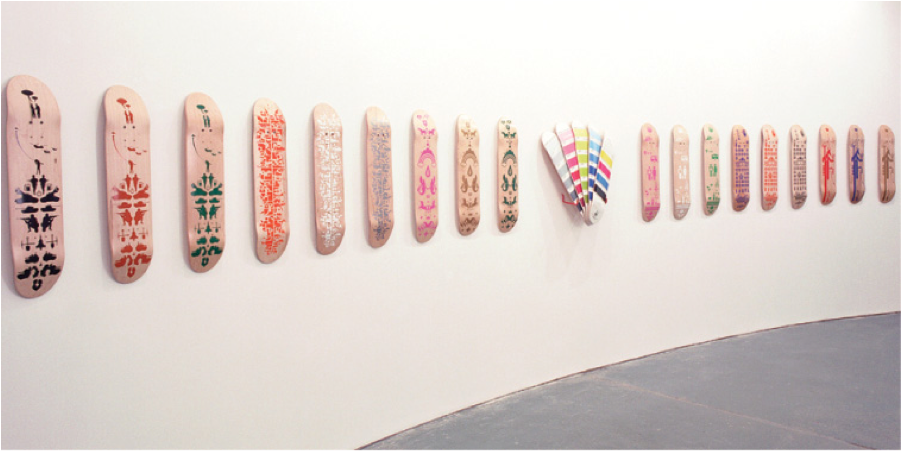
Ryan McGinness

Ryan McGinness is an American artist working in Manhattan. "Known for his original extensive vocabulary of graphic drawings which use the visual language of public signage, corporate logos, and contemporary iconography, McGinness creates paintings, sculptures, and environments."

Here is an artist worksheet I created based off his works. He uses very bright colors that I find eye catching!


How many shapes/ objects can you find here? What are they?

What is negative space? How does the artist create negative space?

What symbols are used here?                    What do you think they represent?        

If you were to represent yourself through symbols, what would you choose?


What makes this an engaging installation?


What is repetition?                                        How does repetition enhance this installation?

Sunday, October 2, 2011

Teacher Examples of Surrealist Lesson

Here are two examples of what I would use for my first lesson.
Inspired by the surrealist games, students would begin by playing the sentence game!
This is great for people all ages.
Begin with a group of 4 or more--each person has a pile of papers about 5 or 6 sheets high--the game begins by each player writing a random, descriptive sentence on the first sheet-- pass the pile to your left-- based off the sentence, draw a picture that illustrates what the first player wrote-- place sentence underneath pile-- create sentence based off picture.
And so on and so forth-- when everyone finishes with the last sheet of paper, go around the circle and share! You will get a good laugh from this exercise.

Here are some of the examples from when I played with my group.


(Sorry, you are going to have to tilt your head to read this one!)


After the groups play this warm up game they will have to collaborate to create a final piece. It can be a narrative piece or abstract involving some of the images drawn and words used.

Here are some of the examples I came up with from the warm up games.


What words would you add to this drawing?


Postmodern Abstract Art Book


After creating the Principles and Elements Panorama Art Book using the given instructions, I have recreated it by incorporating Postmodern Principles into the instructions. 

Postmodern Principles (PMP):
Appropriation, Juxtaposition, Recontextualize, Layering,
Text and Image, Hybridity, Gazing, Representing

Materials:
Magazines
Scissors
Glue sticks
Markers
Colored Pencil


1. Choose a single shape. Make 10 or more of your chosen shape.

2. Make these with variations of size or form. Experiment with the PMP Layering. Layer your shapes and paste down on first panel after discussing the technique of layering.

3. Create emphasis by adding images cut in the shape you chose. Paste to second panel.

4. Create emphasis and contrast by experimenting with text and image. Add text to your images on the same panel. Discuss PMP Interaction of Text and Image, how the text relates to the images, if the words are self explanatory or if more descriptive words are needed.

5. Recontextualize images chosen on next panel. Use markers or colored pencils to put your subject chosen in a different context.

6. Choose one more PMP for the last panel. See if you can incorporate images, shapes, or PMP from the earlier panels to create a sense of unity throughout all panels.